Mastering the art of cornering separates amateur dune buggy drivers from true desert warriors. While accelerating in a straight line might seem thrilling, the real test of skill comes when you encounter a sweeping turn across a steep dune face or need to navigate tight corners between sandy ridges. Knowing some helpful dune buggy cornering tips transforms potentially dangerous situations into controlled, exhilarating maneuvers that showcase your growing expertise.
Whether you're planning your first desert adventure or seeking to refine existing skills, these proven techniques will help you tackle Dubai's challenging terrain with confidence and precision.
The Physics Behind Sand Turning
Before diving into specific techniques, understanding why sand behaves differently from asphalt helps you anticipate your buggy's responses. Sand constantly shifts beneath your tires, creating an unstable surface that eliminates the consistent grip you'd find on paved roads. Your dune buggy handling skills must account for several unique factors:
Variable Traction: Sand density changes dramatically based on moisture content, temperature, and previous vehicle traffic. Darker, more compact sand offers superior traction compared to loose, light-colored sand that your tires sink into easily.
Weight Transfer: During turns, your buggy's weight shifts to outside wheels. On unstable sand, this can cause inside wheels to lift dangerously, potentially leading to rollovers if you're traveling too fast or turning too sharply.
Momentum Management: Unlike paved surfaces where braking helps control speed through corners, sand requires maintaining momentum to prevent getting stuck while simultaneously avoiding excessive speed that causes loss of control.

Essential Pre-Turn Preparation
Successful cornering begins well before you reach the actual turn. Professional desert riders emphasize that mastering dune turns requires anticipating challenges and preparing your approach systematically.
Scout Your Line: Always look several dunes ahead, not just at the immediate turn. This forward vision allows you to choose the optimal path, identify potential obstacles, and plan your speed accordingly. The best dune riders are constantly scanning three to four dunes ahead, acquiring the sense of dune flow that only experience develops.
Adjust Your Speed: The single most critical decision is determining appropriate entry speed. According to dune driving techniques from the experts, you should slow down before entering turns rather than braking mid-corner, which destabilizes your buggy and increases rollover risk.
Taking the Turn Itself: Execution Techniques
When you've prepared properly, executing the turn becomes a symphony of smooth, coordinated inputs that work with sand's unique properties rather than fighting against them.
Steering Input (Smooth and Decisive)
One fundamental dune buggy cornering tip is using smooth, sweeping turns rather than sharp, jerky steering movements. Keep your steering wheel pointed exactly where you want to go, avoiding overcorrection that makes your buggy flip-flop from side to side. Many drivers instinctively overcorrect when they feel their rear end sliding, but this typically worsens the situation rather than improving it.
For tight corners where space is limited, slow significantly before the turn, then use steady steering pressure to guide your buggy through the arc. Avoid turning sharp into high-speed corners, which dramatically increases rollover risk, especially on side slopes.
Throttle Management (The Power Balance)
Understanding how to corner safely in a dune buggy means mastering throttle control throughout the turn. Maintain steady throttle rather than chopping power completely, which can cause your buggy to dig into sand and lose momentum. However, avoid aggressive acceleration mid-turn, which causes your rear wheels to break traction and swing the rear end out.
The technique varies based on turn type:
Flat turns: Maintain consistent throttle throughout, allowing momentum to carry you through while gently modulating power to maintain your line.
Uphill turns: Gradually increase throttle as you climb, compensating for gravity's pull while avoiding wheelspin that indicates you're overpowering available traction.
Downhill turns: Use engine braking combined with light brake application if necessary, keeping weight balanced and avoiding locked wheels that cause uncontrolled slides.
Advanced Technique (Controlled Drifting): Once you've mastered basic cornering, controlled drifting adds another dimension to your dune buggy handling skills. This technique intentionally breaks rear-wheel traction to rotate your buggy through corners, similar to rally driving but adapted for sand's unique characteristics.
Start practicing in tight turns on relatively flat terrain where consequences of mistakes remain minimal. Determine exactly how much speed, steering input, and throttle it takes to get inside tires light and feel that distinctive sensation of your buggy starting to rotate. Test this limit slowly in predetermined corners for both turning directions, as vehicles often behave differently based on weight distribution and drivetrain configuration.
Gradually increase speed as comfort grows, then graduate to side hills once you've developed consistent control on flat surfaces. The key is keeping steering tires pointed where you want to go while modulating throttle to control rear-end rotation.
Best Techniques for Sand Dune Cornering
Professional desert guides emphasize several proven strategies that represent the best techniques for sand dune cornering across various terrain types:
The Four-Wheel Drive Advantage: Most experienced riders recommend four-wheel drive for cornering, especially for beginners. While two-wheel drive allows more dramatic drifts and tail-out slides, four-wheel drive provides predictable, planted cornering that builds confidence. You can experiment with two-wheel drive once your skills develop, but initial learning benefits significantly from four-wheel drive's stability.
Body Positioning Matters: Your body position affects your buggy's balance during turns. On side-slope turns, lean slightly uphill to counteract gravitational pull and keep weight centered over your buggy's footprint. This subtle weight shift helps prevent the downhill slide that catches many inexperienced riders.
Tire Pressure Optimization: Tire pressure dramatically influences cornering characteristics. Lower pressure (around 7 to 10 PSI for desert driving) increases your tire's contact patch with sand, improving both traction and floatation. However, excessively low pressure makes steering feel mushy and reduces responsiveness. When booking through services offering buggy rental in Dubai, ask operators about optimal tire pressure for current conditions and your skill level.
Common Cornering Mistakes to Avoid
Even experienced riders occasionally make errors that compromise safety and performance:
Braking Mid-Turn: Using brakes while actively cornering shifts weight forward and reduces rear traction, potentially causing spins or slides. Complete most braking before entering turns.
Looking at Obstacles: Your buggy naturally goes where you look. Focus on your desired path, not on obstacles you want to avoid. This mental discipline proves surprisingly difficult initially but becomes intuitive with practice.
Rigid Steering Inputs: Tense, jerky steering creates unpredictable responses. Maintain relaxed grip pressure and make smooth, flowing adjustments rather than sudden corrections.
Ignoring Terrain Angle: Traversing dunes sideways at steep angles courts disaster. If you find yourself on a pronounced side slope, point your buggy either up or down the slope rather than maintaining the dangerous sideways trajectory.
Building Your Cornering Skills Progressively
Mastering dune turns requires patient, systematic skill development rather than immediately attempting advanced maneuvers.
Start with these progression steps:
Level 1: Flat Terrain Practice Begin on relatively flat, open areas where you can practice basic turning without slope complications. Focus on smooth steering inputs and consistent throttle management.
Level 2: Gentle Slope Navigation Graduate to mild slopes once flat-terrain cornering feels natural. Practice both uphill and downhill turns separately before combining them.
Level 3: Steeper Challenges As confidence builds, tackle steeper dunes and tighter corners. Always have escape routes planned should situations develop beyond your comfort level.
Level 4: Variable Conditions Practice in different sand conditions, loose versus compact, dry versus damp, to understand how your buggy responds to varying traction levels.

Safety First: Important Considerations for Cornering Practice
While developing your cornering skills, prioritize safety through proper equipment and conservative decision-making:
Protective Gear: Always wear DOT-approved helmets, goggles, gloves, and secure clothing. Most reputable rental operations provide this equipment, and wearing it properly proves especially crucial during cornering practice when rollover risks increase.
Graduated Speed Increases: Resist the temptation to immediately corner at high speeds. Gradually increase velocity as technique improves and comfort grows.
Practice with Spotters: Having experienced riders observe your technique provides valuable feedback about body positioning, steering smoothness, and line selection that you cannot assess while concentrating on driving.
Know Your Limits: If a turn looks beyond your current skill level, there's no shame in finding an alternative route or seeking guidance. The desert will still be there when your skills develop further.
Bold and Fun: The Path to Cornering Mastery
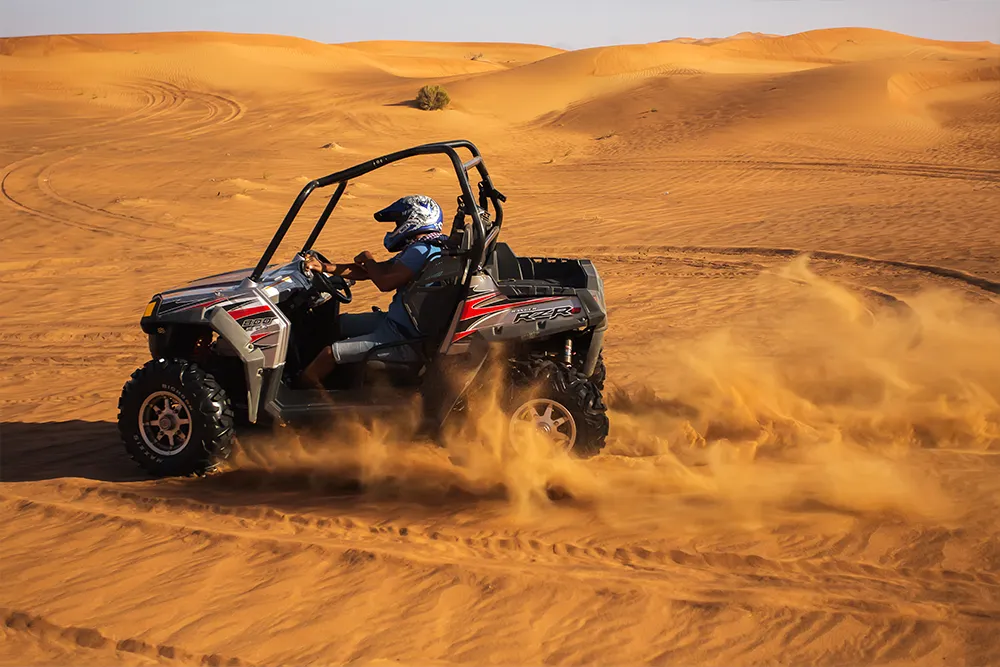
Developing expert dune buggy cornering knowledge transforms desert riding from merely surviving the terrain to genuinely mastering and enjoying it. The satisfaction of smoothly flowing through a challenging turn, maintaining perfect control while sand sprays from your tires, represents one of off-roading's purest pleasures.
It doesn’t matter if you're experiencing your first desert buggy adventure or refining skills developed over years, remember that cornering mastery comes through patient practice, careful observation, and willingness to learn from both successes and mistakes. Start conservatively, focus on fundamentals, and gradually push your limits as confidence and competence grow together.
For those planning desert adventures in Dubai, understanding proper preparation and safety measures ensures your cornering practice occurs in optimal conditions with appropriate support. The golden dunes await your conquest. Turn, drift, and conquer with the confidence that comes from genuine skill and knowledge.
FAQs
- How should I approach a turn in the sand?
Reduce your speed before sharp turns. Sudden braking before cornering can destabilize the vehicle and cause an accident.
- How does speed affect cornering in a dune buggy?
Speed is crucial when cornering. The higher the speed, the more cornering force that is generated, increasing the risk of losing control of the vehicle. It’s important to be careful.
- What kind of steering input should I use?
Use gentle and smooth steering inputs when cornering with your dune buggy.









 Or drop us a mail at help@beno.com